
June Run Down


Please note, this piece was originally published in From My Search Bar, first in the print club and will be published online as well.
I was 14 years old the first time someone suggested that I might be gay. I had a friend that I had deep feelings for that I couldn’t understand, much less label. My dad had just come home from five months in the hospital, wheelchair bound, a completely different person than he was five months before. The suggestion that I was gay wasn’t so much a suggestion as an accusation. The implications felt worse than everything going on—worse than a sick dad, worse than starting at a new school; it was something unspeakable. It was a secret I knew I’d keep forever, a version of me that could never exist.
From that day forward, I knew who I was, but I also knew it would ruin my life. I tried to hide it, I buried my feelings in sports, in school, in caring for my dad. I strived to be outwardly perfect so nobody would know the secret I was carefully hiding. I had friends, I had family, I had hobbies, and yet, there was a part of me that I didn’t share with anyone.
Every subtle message, every not-so-subtle slur that I heard was the constant reminder that no matter what I did to control it, there was always going to be a part of me that some people hated. Over time, I began to believe that I was better off dead than gay, so I vowed never to be my true self. I would be who people needed me to be, who people expected me to be.
The problem was that as time went on, it became harder and harder to maintain the ‘perfect’ persona. Hiding secret relationships was hard, but harder still was hearing homophobic comments from those around me. Once, I heard people claiming that all LGBTQ+ people were pedophiles, and I couldn’t stay quiet anymore. I didn’t even explicitly say that I was a lesbian; I just tried to put a stop to the hateful comments. But it didn’t matter; I was still confronted and accused of being a lesbian. The denial rolled off my tongue so easily; I’d been telling the same lie for years, but this time, something shifted, and it felt wrong coming out of my mouth. That was the last time I lied because at that moment, I knew I had to ruin my life, realizing it was my only chance to save it.
Making the conscious decision to come out and actually coming out were two very different things. The day I took the leap, I couldn’t stop crying. The tears weren’t because I regretted telling people, and it wasn’t because I doubted who I was. I simply knew that I was destroying the persona I had fought so hard to maintain, and in doing so, I would inevitably change my life forever. I was right—friendships were lost, relationships permanently altered. It was devastating, and it felt like it was my fault for trying to live more authentically.
Online, I saw the freedom and joy people had coming out, but that wasn’t my experience. For me, coming out didn’t feel like a new lease on life; it didn’t feel like a new beginning. It felt like I ruined my life, it felt like I lost everyone, and I didn’t know where I could possibly go from there. I thought hiding was hard, but being out was its own type of agony.
However, my life wasn’t ruined even when it felt like it was. When I began studying queer history, I suddenly felt like I was part of something larger than myself. I realized that even though I felt wholly alone, LGBTQ+ folks had existed for centuries upon centuries; it wasn’t something new or scary; it was just another way to exist in the world.
Growing up in a small town, it was easy for me to assume that my experiences with queerness, with homophobia, and with coming out were universal. However, when I finally had the opportunity to move to a big city, it opened my eyes to a society that largely didn’t care if I was a lesbian or not. Sure, there were homophobic people here and there, but the way I had become accustomed to constantly feeling suffocated simply by being myself wasn’t the reality anymore. I no longer made friends despite my being a lesbian; people actually wanted to be my friend and loved all of me, even the queerness.
The truth is that progress was slow; it wasn’t something that happened overnight. It took years of bravery and unlearning. But recently, I looked at my life with awe and wonder. I was scared and broken for so long; I never could have imagined how full my life is now—full of friends, full of hope, full of joy.
As someone who hid behind lies and secrecy and an ocean of fear for so many years, I can scarcely believe that I run an LGBTQ+ publication dedicated to queer history and LGBTQ+ artists. I write about queerness, my life, queer history, and LGBTQ+ artists. I write about the history that was my first lifeline, the first indication that maybe things could get better. I created what I needed growing up, and I will always be deeply proud of that.
Often, I hear jokes surrounding Pride Month about rainbow capitalism, or I hear jeers about why this month shouldn’t exist. Maybe it’s well-meaning, maybe it’s malicious. I sometimes hear people talk about how “easy it is to come out nowadays.” The thought process being that maybe Pride Month isn’t needed anymore, maybe we have enough pride. While it’s true that some progress has been made, there is also much work to be done. And, it’s also true that coming out is easier for some, but it’s important to remember that it is still devastating for others; I’m an example of that.
For me, pride is a month of hope and promise, a month that is necessary. It reminds me that I was brave enough to destroy my life in the hope I could rebuild it as my authentic self. It connects me to the queer leaders throughout history, who, without ever knowing me, saved my life time after time. I think about Sylvia Rivera and Marsha P. Johnson, who existed loudly and made me think I could too. I remember the AIDS activists who didn’t back down in the face of fear, loss, and death, who taught me I could be brave. I remember Magnus Hirschfeld, who was ahead of his time, believing that science proved homosexuality was natural and normal. I think about the countless queer people whose lives were taken too soon, who made me pause and save my own life; I could live for them until it felt safe enough to live for me. None of these people knew me, few of them are alive anymore, yet they changed my life, they saved my life, and now I get to share their stories with people every day.
Maybe parts of Pride Month are cheesy, maybe companies with crazy rainbow merch are a bit tacky, but this month isn’t about that. It’s for us to remember, it’s for us to hope, and it’s a time for us to remind those who are scared and in the closet that their lives aren’t over even when they feel like they are.

The Body And The Blood by Renee Christine
One of the Greats by Florence + The Machine
Dan by Noah Kahan
Hanging Out To Dry by Florence Road

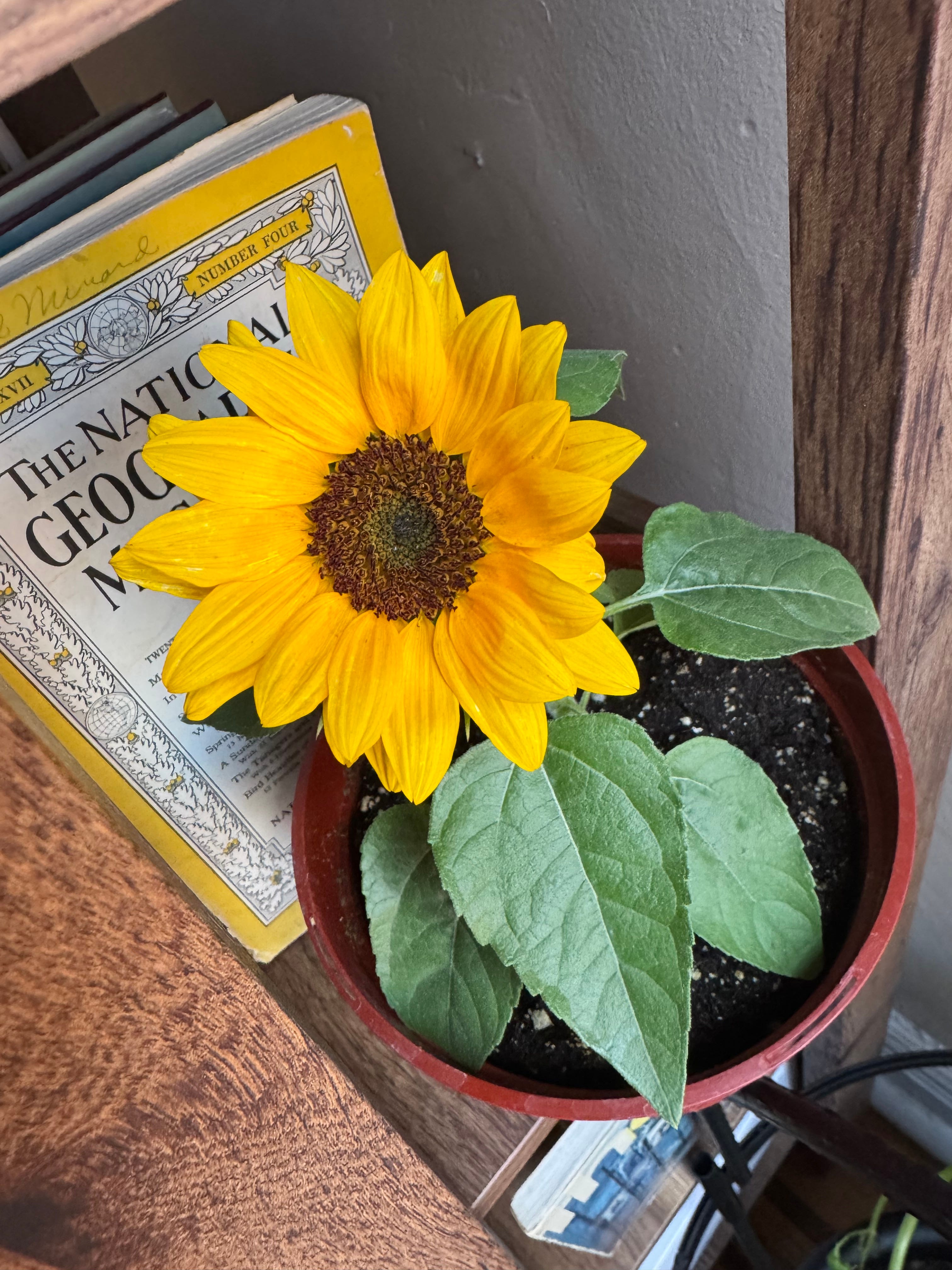
I LOVE plants and am very excited about this little sunflower I got from a farmers market.

I want to touch on a topic I’ve been researching for a new piece I’m writing, and that’s looking at lesbians in the context of Satanic Panic and witch hunts.
Malleus Maleficarum (”Hammer of Witches”), published in 1487 by German Catholic clergyman Heinrich Kramer, was a manual used to identify and punish witches. As with all witch hunts, women were the primary focus, so it’s not surprising that lesbians would be included in this. In fact, because many lesbians defied gender roles, they were particularly targeted.
In the Malleus, a lot of focus is on female sexuality, basically framing witchcraft as a female and sexual crime.
As the McGill Department of English Undergraduate Review writes, “Malleus Maleficarum thus not only invokes a gendered, feminine conception of witchcraft, but suggests that women’s bodies and the sexual deviancy of witchcraft are inherently tied. In doing so, Malleus presents a deadly opposition between the sexes and posits that it is only under the staunch policing of women’s sexuality that they do not turn to the corruptions of the Devil.”
What’s interesting is that during this era, there wasn’t a word to describe lesbianism. Still, with the extreme misogyny in the text, paired with the obsessive focus on women’s sexuality, and targeting those who didn’t fit traditional society’s idea of what a woman was, it seems very reasonable that lesbians were impacted by the witch hunts occurring.

In case you missed it, these articles were published this month:
In Conversation with Gabrielle Korn
Daughterhood is Sweet with PSSY2CNT